Sauna Ventilation Requirements: A Practical Guide for Safe Home Saunas
In the pursuit of modern wellness, there's a growing desire for daily rituals that support both body and mind. We are increasingly seeking to create personal sanctuaries within our homes, spaces dedicated to intentional well-being. The steam sauna, a time-tested practice now supported by science, has emerged as a cornerstone of this movement, offering profound benefits that are more accessible than ever.
The true value of steam bathing lies in its holistic impact. It is a powerful tool for detoxification, as the enveloping warmth induces a deep sweat that helps flush toxins from the body. This heat also boosts circulation, delivering oxygen-rich blood to your skin and muscles, which promotes a healthy glow and aids in recovery. For many, the experience brings remarkable respiratory ease, opening airways and fostering a sense of clarity.
Beyond the physical, the mental benefits are equally compelling. The gentle heat quiets the mind, melts away stress, and guides you toward a state of deep relaxation. This is where Mande Spa enters the picture—as the brand dedicated to bringing this transformative experience to life in your home.
The Mande Spa Difference
At Mande Spa, we position ourselves as experts committed to quality materials, elegant design, and engineering excellence. We understand that a sauna is not merely an appliance but an integral part of a modern home—a piece of wellness architecture. That's why we build our saunas for both performance and beauty, using premium materials that make them a seamless addition to any home.
A well-designed sauna is an investment in your daily well-being. It’s a space where the noise of the world fades, allowing you to reconnect with yourself and emerge renewed.
We engineer our saunas to be exceptionally energy-efficient, safe, and easy to use, addressing practical concerns while reinforcing our premium positioning. Our commitment to quality means our saunas ship from within the USA and are not lower-quality imports.
Ready to create your personal sanctuary for daily renewal? We warmly invite you to see the Mande Spa Outdoor collection and imagine how a steam sauna could elevate your home and your health.
Why Proper Sauna Ventilation Is Non-Negotiable
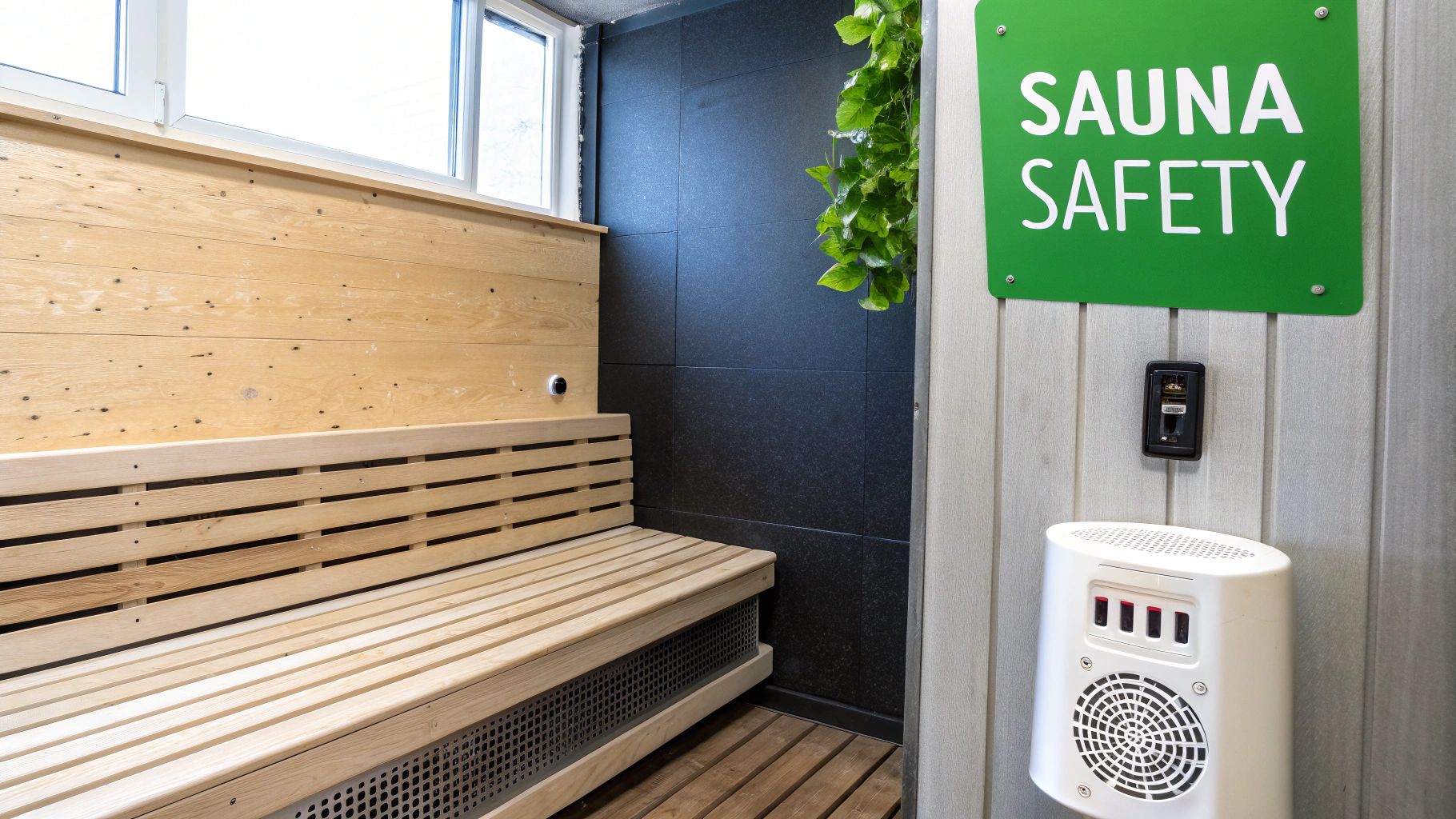
Think about settling in for a cozy chat by the fire, only to find the chimney is blocked. The room would turn stuffy, uncomfortable, and frankly, unsafe in a hurry. That's a perfect picture of why sauna ventilation requirements aren't just a technical footnote—they're the very heart of a safe, incredible, and long-lasting sauna experience.
A great ventilation system is essentially the lungs of your sauna. It needs to breathe in fresh, cool air and exhale the hot, humid air. This constant, gentle exchange is the secret to protecting both your well-being and the beautiful wood of your sauna for years to come.
Your Health and Safety First
Above all else, proper ventilation is about keeping you safe. As you relax and breathe deeply in the heat, you're naturally using up oxygen and releasing carbon dioxide. Without a steady stream of fresh air, that environment can become stale and depleted, which might lead to dizziness or just feeling "off."
An effective system ensures a constant flow of oxygen-rich air, making every session feel refreshing and invigorating, not stuffy. It's your invisible guardian, letting you sink into the therapeutic heat without a worry in the world.
Protecting Your Sauna Investment
Your sauna is a wonderful investment in your health, and you want to protect it. The combination of high heat and steam creates a perfect storm for moisture to settle where it doesn't belong. Trapped moisture is the number one enemy of wood, leading to decay, warping, and even mold or mildew.
Proper ventilation is the key to longevity. By continuously moving humid air out and dry air in, it prevents moisture from settling into the wood, preserving the structural integrity and pristine beauty of your sanctuary.
This active air exchange keeps your sauna a healthy, clean, and welcoming space. To keep everything in top shape, a good understanding of home-wide air ventilation cleaning is a smart move for any sauna owner.
Enhancing the Quality of Your Session
Finally, ventilation has a massive impact on how good your sauna session actually feels. It's the engine that drives even heat distribution, getting rid of those "hot spots" near the ceiling while eliminating cold pockets down by your feet.
By drawing cool air in near the heater, the system works with physics, allowing the newly heated air to rise and circulate naturally. This creates that consistent, enveloping warmth that defines a truly therapeutic sweat. Without it, you're simply not getting the full, deeply restorative benefits you deserve.
Decoding Sauna Ventilation Codes and Standards
Diving into the world of sauna building codes can feel a bit like trying to read a foreign language. You’ll see terms like Air Changes per Hour (ACH) and Cubic Feet per Minute (CFM) thrown around, and it can seem intimidating at first. But don't worry—these are just simple tools to make sure your wellness sanctuary is both perfectly safe and wonderfully effective.
Think of it this way: your sauna needs to breathe, just like you do. These codes and standards are the guidebook for making sure it gets a steady inhale of fresh air and a full exhale of the old, humid air. This constant, gentle exchange is what keeps the air quality pristine and the heat feeling just right. It’s the secret behind that perfect, therapeutic warmth you’re after.
The Language of Airflow Explained
One of the most important concepts you'll come across is Air Changes per Hour (ACH). When you see a recommendation for 6-8 ACH, it's a straightforward instruction: the entire volume of air inside your sauna should be completely replaced six to eight times every single hour.
This isn't just a casual suggestion. It's the bedrock of a healthy, inviting sauna, preventing that stuffy feeling and ensuring you have plenty of fresh oxygen for every session.
Knowing how to calculate air changes per hour is a game-changer. It empowers you to design an efficient system from scratch or ask the right questions when you’re looking at a pre-built model.
Translating Codes into a Safe Sauna
Building codes aren't there to make things complicated; they’re a clear roadmap to safety and peak performance. For instance, the International Residential Code (IRC 2021) has some very specific things to say about sauna ventilation. One key rule is a ventilation opening of at least 4 × 8 inches near the top of the door to guarantee proper airflow.
These aren't random numbers. They're based on years of experience and are designed with your well-being in mind. Here's a quick peek at what they typically cover:
- Intake Vent Sizing: Many codes suggest sizing intake vents at 1 square inch per cubic foot of your sauna's space.
- Exhaust Vent Placement: The exhaust vent is usually placed on the opposite wall from the intake, creating a natural cross-breeze.
- Ceiling Clearance: For an exhaust vent to work its magic, it often needs a minimum clearance of 6 inches from the ceiling.
These standards ensure a predictable, safe, and comfortable airflow pattern, turning technical requirements into a tangible, high-quality sauna experience.
This is precisely why putting your trust in a reputable brand makes all the difference. When you invest in a well-crafted sauna from a brand like Mande Spa, you’re not just buying a box; you’re buying peace of mind. You know it’s been meticulously engineered to meet—and often exceed—these critical standards. Always feel encouraged to see the Mande Spa Outdoor collection. When you're ready to create your own wellness space, our guide on how to build a sauna room can walk you through the entire process. This lets you skip the worry and focus on what truly matters: your renewal.
The Art of Vent Placement for Optimal Airflow
Getting the perfect sauna climate isn't about brute force; it's about finesse. Think of it as an art form, one mastered by placing vents in just the right spots to harness the natural physics of air. This creates that sanctuary of consistent, enveloping warmth we all crave. The entire process is driven by natural convection—the elegant, silent engine behind every great sauna experience.
The goal is to create a gentle, continuous loop of air. Once you understand how air behaves when it's heated, you can orchestrate this flow perfectly. It all starts with an intake vent drawing in cool, fresh air and ends with an exhaust vent releasing the warm, moist air. When you get this right, you create a seamless cycle that elevates a good sauna session into a great one.
The Science of Natural Convection
At its heart, natural convection is beautifully simple: hot air rises, and cool air sinks. A well-designed sauna uses this basic principle to its absolute advantage. The heater warms the air around it, making it less dense and causing it to float up toward the ceiling. As this air circulates and cools off a bit, it becomes denser and starts to fall, eventually being drawn back toward the heater to start the cycle all over again.
Your ventilation system is what turns this natural dance into a perfect performance.
- Intake Vent: This one belongs low on the wall, ideally right under or very close to your sauna heater. This placement is strategic. It feeds the coolest, densest, and most oxygen-rich air directly to the heating element where it's needed most.
- Exhaust Vent: This vent should be positioned high up on the opposite wall. As the hot, humid air makes its journey across the sauna, this vent provides a clear exit path, keeping the atmosphere from feeling stuffy, stagnant, or overly humid.
This low-intake, high-exhaust setup is the secret to ideal circulation, ensuring fresh air is always coming in while stale air is efficiently ushered out. For anyone looking to get into the nitty-gritty of the build, our guide on how to make a sauna at home covers these foundational principles in more detail.
Mastering Finnish Ventilation Principles
There's a very good reason Finnish saunas are the gold standard—they've spent generations perfecting passive ventilation through hands-on experience and smart engineering. Studies have shown that a properly designed system should deliver around 20-25 CFM (Cubic Feet per Minute) of fresh air for each person inside. Vents with a 2-4 inch diameter are usually all you need, with the intake placed low by the heater and the exhaust high on the opposite wall. Some of the best designs even include a third, adjustable vent near the bench level for even more control.
Decades of research confirm this setup creates remarkably even temperatures and keeps CO2 levels low, aiming for 6-8 complete air changes per hour.
The beauty of this system is its quiet efficiency. It works with nature, not against it, to create a breathing room that feels alive, fresh, and deeply therapeutic.
This meticulous engineering is at the very heart of what we do at Mande Spa. We've taken these time-tested principles and integrated them seamlessly into our designs, so you don't have to become a ventilation expert to enjoy a world-class experience. Our saunas are crafted to perfect this natural process, delivering an intuitive, comfortable, and restorative session every single time.
Not All Saunas Breathe the Same
Think of ventilation as a sauna's lungs—and just like people, different types of saunas breathe in their own unique way. Getting this right is the secret to a perfect, invigorating session every time. A classic traditional steam sauna, with its powerful heat and bursts of steam (löyly), has completely different needs than the gentle, penetrating warmth of an infrared model.
Traditional saunas, firing up to a scorching 80-100°C, are all about managing that intense, humid air. When you toss water on those hot rocks, you need a powerful ventilation system to keep the air moving. This isn't just about comfort; it's about creating that signature crisp, clean heat the Finns perfected. Without robust airflow, the room would feel stuffy and oppressive. Proper circulation is what makes every breath feel fresh and cleansing.
From Infrared to the Great Outdoors
Infrared saunas are a different beast entirely. They heat your body directly, not the air around you, so the ambient temperature is much lower. But don't mistake lower heat for no need for ventilation. You still need a gentle, consistent supply of fresh air to replace the oxygen you're breathing, clear out carbon dioxide, and keep the space from feeling stagnant. It's a more subtle airflow, but it's absolutely essential for a comfortable and healthy session.
Then you have outdoor saunas, which have to contend with Mother Nature. A well-designed outdoor unit needs a ventilation system smart enough to handle a gusty winter day just as well as a calm summer evening. It has to pull in fresh air without creating uncomfortable drafts. This is where truly expert engineering from a brand like Mande Spa makes all the difference, ensuring a flawless escape no matter the weather.
This diagram shows you the basic idea behind how a sauna breathes. Fresh, cool air comes in, gets heated by the stove, circulates, and then stale, warm air is pushed out.
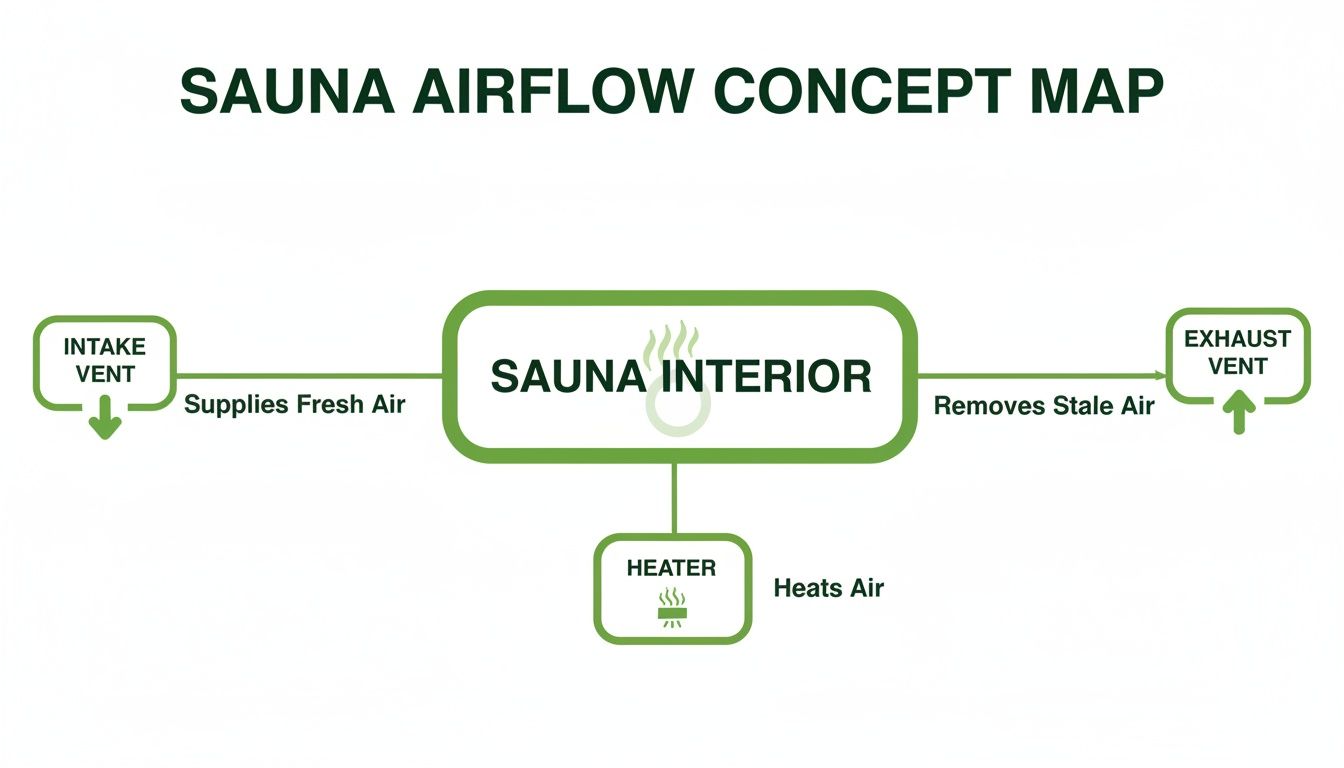
It’s this continuous loop that keeps the temperature stable and the air quality pristine.
But this isn't just a feeling; it's backed by science. Landmark Finnish studies from VTT show that achieving 6-8 Air Changes per Hour (ACH) is the gold standard. This keeps CO2 levels safely in the 582-606 ppm range during a session—well below the 700 ppm mark where air quality starts to decline. It's the science that separates a mediocre sauna from a truly revitalizing one.
"A sauna’s ventilation is its breath. For traditional saunas, it's a deep, powerful breath that manages intense heat and steam. For infrared, it's a calm, steady rhythm that maintains purity and comfort."
Ultimately, no matter which type of sauna you choose, the goal is the same: to create a space that breathes with you, supporting your well-being from the very first moment you step inside. We always encourage you to see the Mande Spa Outdoor collection before making a final decision.
Bringing It All Together: Your Mande Spa Sanctuary
We've journeyed through the science of airflow and the nuts and bolts of proper ventilation. Now, let’s bring it back to what truly matters: creating a personal sanctuary that rejuvenates your body and soul. Getting the sauna ventilation requirements right isn't just about following rules. It’s about transforming a simple hot room into a haven for genuine well-being. This is the heart of what we do at Mande Spa.
We believe that your path to a world-class sauna experience shouldn't be cluttered with engineering challenges. Our passion lies in perfecting every detail for you, from sourcing the highest quality materials to executing elegant, functional designs. Every Mande Spa sauna is a premium, USA-shipped product, a world apart from lower-quality imports.
Engineered for Your Peace of Mind
Picture this: you step into your Mande Spa outdoor sauna. The air feels clean and alive, the heat envelops you perfectly, without a hint of stuffiness. In that moment, you can let go completely, knowing that the performance and safety of your sanctuary are absolute.
This isn't just about adding a new feature to your home. It's about elevating your lifestyle and creating a lifestyle rooted in intentional well-being. We've obsessed over the complex science of airflow so you can focus on the simple, beautiful art of relaxation.
Your personal sanctuary should be a place of trust and tranquility. At Mande Spa, we engineer every sauna to be that space—safe, reliable, and ready to support your daily renewal.
A great sauna quickly becomes the centerpiece of a personal wellness practice—a dedicated space you return to day after day. It’s a powerful commitment to intentional living, and it all begins with a foundation of quality you can feel.
Feeling inspired to create your own wellness retreat from scratch? Dive into our expert guide on building a DIY sauna at home.
We invite you to discover the Mande Spa collection. See for yourself how the right steam sauna can transform your home, your health, and your everyday life. Consider purchasing a sauna to start this journey.
Common Questions on Sauna Ventilation
Diving into the world of sauna design often brings up a few key questions about getting the airflow just right. Let's clear the air on some of the most common queries to make sure your personal wellness retreat is safe, comfortable, and built to last.
Is It Possible to Over-Ventilate a Sauna?
You bet. While good airflow is essential, going overboard can work against you. Too much ventilation can turn your sauna heater's job into an uphill battle, forcing it to constantly struggle to reach and maintain your ideal temperature.
This not only makes for a less satisfying sauna session but also drives up your energy bills. The sweet spot is balanced airflow, which is precisely why the recommended vent sizes and adjustable vent covers are so important—they give you control.
Do I Really Need to Install a Fan?
For the vast majority of home saunas, the answer is no. A well-designed passive system, which uses the natural power of convection (hot air rising), is all you need. With vents placed correctly at low and high points, the air will circulate beautifully on its own.
Mechanical fans are usually reserved for much larger, commercial-grade saunas or very unusual layouts where a natural draft just isn't possible. For your home sanctuary, simple is almost always better.
What About Infrared Saunas? Do They Need Vents Too?
Absolutely, yes. It's a common misconception that because infrared saunas run at lower temperatures, they don't need ventilation. But the goal of ventilation isn't just about managing heat.
Every time you breathe, you're consuming oxygen and exhaling carbon dioxide. Proper ventilation ensures a constant supply of fresh, oxygen-rich air enters the cabin, making every session feel refreshing and safe. It's a non-negotiable for any type of sauna.
Your daily journey to renewal deserves a flawless foundation. At Mande Spa, we obsess over every single detail—especially ventilation—in our premium outdoor saunas. Our saunas are engineered for excellence and shipped from right here in the USA, not imported as a cheaper alternative. Explore the Mande Spa collection today and make a true investment in your well-being.